Found a bug or have an idea? We read every message.
Log in if you'd like us to reply by email.
7 Manhwa Like Mercenary Enrollment Worth Reading Next
KuraManga Team··9 min read
Mercenary Enrollment does something most school-action manhwa skip: it takes the elite-fighter-out-of-place premise and treats both halves seriously. Yu Ijin spent ten years as a child mercenary after a plane crash stranded him abroad at age eight, and the return to Korea isn't a homecoming — it's an enrollment in a high school where the social rules are smaller than the violence rules he learned to survive. The series isn't about teen drama or supernatural ability. It's about an actual former soldier navigating a civilian environment that has no idea what to do with him.
The manhwa below share part of that combination. Some feature modern military killers operating in civilian settings. Some feature mercenaries reborn into noble families their old lives couldn't access. Some feature veteran fighters returning to environments that no longer fit. All of them treat the protagonist's combat background as a real, used skill set rather than a power-fantasy reveal. Every one is available to read on KuraManga.
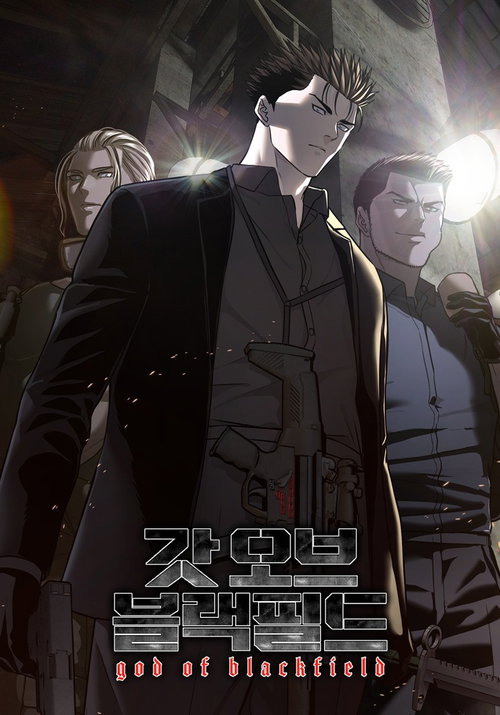
1God of Blackfield
1God of Blackfield
'Who am I?' Kang Chan was the God of Blackfield — the kind of military killer who left only black soot and dead bodies in his wake, a name that struck genuine fear in the people who'd actually heard of him. Then, in the chaos of one specific battle, something interrupted that trajectory hard enough to leave him asking the question above. The story tracks what someone with the God of Blackfield's combat history does when the surrounding world reshapes itself around him without his consent.
This is the closest premise match on the list to Mercenary Enrollment — both protagonists carry the kind of elite combat history that Korean high school environments would not normally encounter, and both stories spend real energy on what that capability does when its standard application is no longer available. Where Yu Ijin is fifteen and dropped into a high school, Kang Chan is older and dropped into a different kind of unfamiliar setting, but the underlying instinct of an elite killer renegotiating with a world that doesn't know him is the same. The art's depiction of Kang Chan's combat sequences has a specific kinetic logic — readers can follow the geometry of his movement, which is rare for the subgenre.
The setup runs darker than the title's bureaucratic language suggests. A nuclear missile codenamed 'Nuclear Warhead' lands in the North, and his sixty-ninth mission is to subjugate the daughter of a wealthy South Korean family. The premise turns on the mismatch between an elite operative's training and the domestic-infiltration assignment that doesn't quite fit any of his conventional skill sets — the kind of mission where his actual combat capability is overqualified and the social skills the assignment requires are underqualified at the same time.
What pairs this with Mercenary Enrollment is the elite-operative-meets-civilian-life framing taken with full seriousness. Yu Ijin's high school is the wrong-shaped problem for a mercenary's training; Nuclear Warhead's assigned target is the wrong-shaped problem for an SSS-Class agent's. Both stories use that mismatch as their actual engine. The series leans further into espionage-thriller texture than Mercenary Enrollment's school-action register, but readers who liked Yu Ijin's tactical adjustment to civilian environments will find the same friction here, just played through political stakes rather than school stakes.
'Because of my bloodline, I wasn't able to rise in status and ended up dying as a mere mercenary.' That's the protagonist's framing, delivered with the kind of bitterness that the rebirth doesn't immediately erase. The second life drops him into a noble household his original life couldn't access through any mechanism he had available, and the story tracks what someone with mercenary instincts does when handed political resources he was previously locked out of.
Mercenary Enrollment's Yu Ijin returns from mercenary work to a Korean high school where his capabilities don't have an obvious application; this protagonist returns from death to a noble household where his capabilities are overqualified and his social position is suddenly elevated past his original training's intended scope. Both stories use the gap between fighting expertise and social environment as the actual engine. The series is by the studio behind Academy's Genius Swordsman — the studio's track record with this kind of dual-track action-and-politics manhwa shows in the pacing.
4A Mercenary's Second Playthrough is Anything But Peaceful
4A Mercenary's Second Playthrough is Anything But Peaceful
A hardened mercenary gets another run at his brutal world and uses that experience to fight smarter — the same seasoned-warrior-among-newcomers energy that drives Mercenary Enrollment. Expect sharp combat and a protagonist who's always the most dangerous person in the room.
Logan McLain is a middle-aged knight fighting for the independence army when the kingdom's fall and his brother's execution by the empire reshape what's left of his life. He dies in battle intent on revenge, and the regression that follows arrives with the kind of memory that doesn't let him pretend any of it didn't happen. The story tracks what someone with that history does with a second pass through the same circumstances.
Mercenary Enrollment's Yu Ijin returns to family life after ten years of combat. Regressor of the Fallen Family runs a different family-and-combat configuration — middle-aged knight rather than child mercenary, fantasy independence army rather than modern foreign mercenary contracts — but the underlying instinct of an elite fighter whose family stakes drive his combat decisions is structurally similar. The series leans into the political-fantasy frame more than Mercenary Enrollment's modern-school setting, but the family-protection drive that anchors Yu Ijin's school arcs anchors Logan's regression in the same way. The art handles middle-aged-knight body language with attention most fantasy manhwa skip.
Humanity's home is no longer Earth — interstellar travel has become commonplace, and technology has progressively replaced blood and flesh in ways the older generations are still adjusting to. Luka grew up in the slums and turned fifteen the year the empire's military selection arrives at his neighborhood. The selection isn't optional, and the training that follows tracks what happens to a slum kid whose surviving habits already include violence the formal military hasn't quite categorized.
What pairs this with Mercenary Enrollment is the child-soldier framing, just played at a different scale. Yu Ijin became a mercenary at eight after his parents died; Luka enters a military selection at fifteen with a slum upbringing already shaping his combat instincts. Both stories take the formative-violence aspect of the protagonist's youth seriously rather than as backdrop. Bad Born Blood's interstellar science-fiction setting puts the framing in a different register than Mercenary Enrollment's modern Korea, but readers who responded to the trauma-shapes-the-soldier engine will find similar weight here.
A battle-hardened soldier is reborn and carries a lifetime of combat instinct into a new life, mirroring the veteran-outclasses-everyone appeal of Mercenary Enrollment. Its grounded military action and unshakable lead make it an easy recommendation for fans of the original.
What Mercenary Enrollment Gets Right About the Elite-Fighter-Out-of-Place Story
Most action manhwa solve the elite-fighter premise with a single beat — the protagonist's training is established in a flashback, deployed in a few satisfying fights, and never has to negotiate with the surrounding world's actual social rules. Mercenary Enrollment refuses that compression. Yu Ijin's mercenary instincts run on a register the high school environment can't read, and the gap between what he sees and what his classmates see drives both the comedy and the drama. The picks here that share that texture treat the elite-background protagonist's adjustment to civilian environments as the actual subject. God of Blackfield drops Kang Chan, the modern-military killer known across his old battlefield as the God of Blackfield, into circumstances where the violence he was made for has no obvious application — and the series spends real time on what he does when the answer to every problem isn't obviously a kill order. SSS-Class Undercover Agent runs the elite-operative-meets-civilian-life premise more directly: the protagonist's mission to subjugate a wealthy South Korean family's daughter requires him to operate inside a domestic environment his combat training did not prepare him for.
The other thing Mercenary Enrollment understands is that the protagonist's combat capability is the answer to wrong questions. Yu Ijin can disable a roomful of bullies; he cannot easily navigate the school's gossip economy. The series uses that mismatch as the actual engine, and the picks here that share it run the same instinct. A Mercenary's Rebirth Among Nobles drops a bloodline-blocked mercenary into a noble household where his fighting expertise is overqualified and his social skills are underqualified at the same time. The Regressed Mercenary Has a Plan handles a more politically explicit version: Cecil Perdium, the Mercenary King, has full memory of Duke Delphine's role in destroying his family, and the regression's real value is the chance to deploy his combat capability inside the political system that actually killed him last time. Regressor of the Fallen Family takes the same instinct further into the family-revenge frame. The elite-fighter manhwa that get this right are the ones where the protagonist's capability runs into environmental friction rather than just stomping through it.
More Manhwa Like Mercenary Enrollment on KuraManga
These didn't make the main list but each captures a slice of what makes Mercenary Enrollment click — whether it's the soul-selling-mercenary-job-hunting framing, the academy-instructor protagonist, or the apocalypse-veteran returning to a world that has moved on.
Dimensional Mercenary - The Soul Sellers website is a job-hunting platform for those willing to sell their souls — a darker take on the mercenary-meets-civilian premise where the contracts have spiritual rather than just financial cost. The dimensional-travel framing is fantasy-leaning rather than Mercenary Enrollment's grounded modern register, but the protagonist's mercenary professionalism translates cleanly.
First Instructor - Kang Jun-Seong is registered with a certified brokerage academy through a friend, and the academy's Ilta instructor So-ra Han enters his life through that registration. The academic-instructor framing pairs with Mercenary Enrollment's school-environment focus, just delivered through a brokerage-academy lens rather than a high school one.
Veteran of the Apocalypse - An apocalypse veteran returning to circumstances that have moved past the war he survived — the kind of premise that asks what someone shaped by extreme events does inside a world reshaping itself around the assumption that those events are over. Less directly comparable to Mercenary Enrollment's school setting, but the veteran-out-of-place register pairs.
Where to Start
If the modern-military-killer premise hit hardest, God of Blackfield is the closest tonal match — Kang Chan's elite-killer status mirrors Yu Ijin's mercenary background almost exactly, just played through a more adult military framing. For the elite-operative-meets-civilian-life angle specifically, SSS-Class Undercover Agent runs the espionage-into-domestic-environment premise with the comedic-and-tactical balance Mercenary Enrollment readers tend to gravitate toward. If the mercenary-into-noble-house framing was the appeal, A Mercenary's Rebirth Among Nobles handles the bloodline-blocked-mercenary-rebirth premise with the same kind of overqualified-protagonist friction Yu Ijin runs into at his Korean high school.
All seven main picks — and the quicklist additions — are free to read on KuraManga. No account, no locked chapters. Just pick where you want to start.
The KuraManga Team is a group of manga and manhwa readers who write guides, reading lists, and recommendations for fans worldwide. Every article is written by people who actually read the medium.